Cultural Differences in Real Work Situations
Understanding these contrasts helps avoid delays, improve communication, and make collaboration smoother, especially in fast-paced AEC development projects, where precision and timeline expectations are high.
| Area | U.S. | Ukraine |
|---|---|---|
| Communication Style | Clear turn-taking, often structured. People pause and let others speak. | Fast-paced, overlapping speech is common. May interrupt to clarify or show engagement. |
| Speech Pace | Moderate pace. People wait for others to finish their thought. | Faster pace. Conversations often overlap. Note: When speaking English as a second language, Ukrainians may slow down and pause more to formulate thoughts. |
| Ownership & Initiative | Initiative expected, but actions typically stay within defined responsibilities unless told otherwise. | Initiative often extends beyond role boundaries, especially if someone sees a better/faster solution. |
| Updates & Check-ins | Regular updates expected. Silence often seen as a problem. | "No news is good news." People assume things are fine unless problems arise. |
| Feedback Style | Framed positively; directness is often softened to preserve harmony. | Direct and unfiltered, especially in technical teams. Bluntness signals honesty, not disrespect. |
| Task Interpretation | Scope boundaries are usually respected. If unclear, clarification is expected before action. | People often reinterpret tasks to improve or shortcut them. May not always inform others first. |
| Team Mentality | Strong emphasis on structured teamwork and role clarity. | Team spirit strong, but individual initiative within team is prized. |
Historical Influence: Why These Differences Exist
U.S.
U.S. workplace norms evolved in a corporate environment that values structure, systems, and
predictability. Key factors:
⦁ Clear expectations: Documented updates, recurring meetings, and defined responsibilities are standard. Project management tools like Jira, Confluence, or Asana are used not just for tracking, but as central communication hubs.
⦁ Polished communication: The workplace favors clarity, diplomacy, and managing tone. Employees are often trained in how to deliver feedback constructively and align with company messaging.
⦁ Ownership within role: Initiative is welcomed, but major decisions tend to be hierarchical and documented. Even when individuals take the lead, they are expected to loop in stakeholders and log changes appropriately. "Chain of command" matters.
⦁ Risk management: Communication is part of risk mitigation. Even small updates help ensure alignment and reduce misunderstandings. Silence can be interpreted as lack of progress.
⦁ Speech pace and structure: Americans are accustomed to moderate speech pace with clear turn-taking. Overlapping speech may feel interruptive rather than engaged. Structured dialogue, often led by an agenda, keeps conversations focused. People value having space to fully express a thought before others jump in.
Ukraine
Ukraine’s work culture evolved through multiple historical layers. Before Soviet rule, Ukrainian
regions were influenced by Polish, Austro-Hungarian, and Russian governance, which emphasized both
collective responsibility and personal resilience.
Under the USSR, bureaucracy was slow and top-down, so people developed informal networks and
personal initiative to get things done. That still influences how Ukrainian professionals operate
today:
⦁ Peer contact & initiative: People are used to bypassing bureaucracy and going straight to the person who can help.
⦁ Direct feedback: Honesty and competence often mattered more than polished communication.
⦁ Process skepticism: Processes were often symbolic or inconsistently enforced—people follow them now only if they add real value.
⦁ Generational shift: Older managers may retain hierarchical habits, but younger IT professionals favor agility, autonomy, and team decision-making.

How These Show Up in Daily Work
Communicating Project Updates
U.S.: Managers expect regular check-ins and documented updates. Silence often signals a problem
or disengagement. Updates are part of the workflow and seen as a proactive way to manage risk and
foster trust.
Ukraine: "No news is good news." Unless there’s a problem, people won’t over-communicate.
Updates are often bundled at the end of a sprint or milestone. People may see frequent status
meetings as redundant unless there’s something to report. Proactive updates might feel performative
or unnecessary.
Tips:
⦁ If you're managing a Ukrainian team, clarify your update expectations early.
⦁ For U.S. teams, don't interpret a quiet team as disengaged, check in directly.
Handling Speech Pace and Interruptions
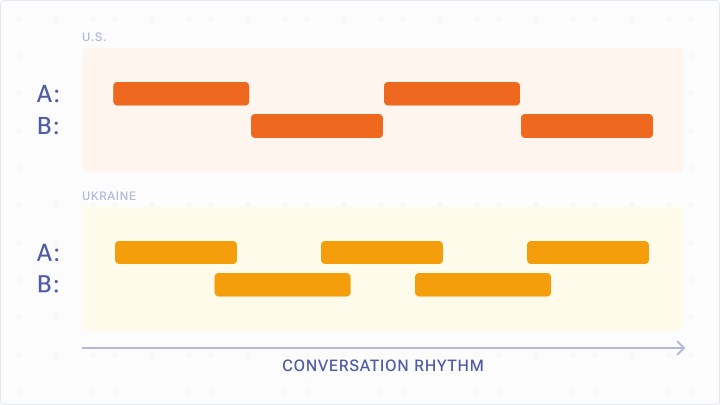
U.S.: Conversations typically follow a steady rhythm. Each person waits for their turn to speak,
and overlapping can feel disrespectful or chaotic, especially in meetings.
Ukraine: Conversations often move quickly and may involve frequent interruptions, especially
when participants are engaged. This isn’t intended to be rude, it’s part of the rhythm of showing
interest and enthusiasm.
Tips:
⦁ U.S. participants should flag when they feel cut off and set norms for turn-taking, especially in mixed teams.
⦁ Ukrainian speakers should slow down and pause more in English, especially in client-facing settings.
⦁ If interruptions happen frequently, establish a shared signal (like raising a hand or using chat) to keep things constructive.
Giving and Receiving Feedback
U.S.: Politeness is often layered into critique. Negative feedback is usually given in private,
and often with a positive framing to soften the impact.
Ukraine: Feedback tends to be direct and fast, especially in tech teams. A comment like "this
doesn't work" or "this part is bad" isn’t personal—it’s just factual. The assumption is that honest
critique saves time.
Tips:
⦁ Ukrainian teams may need coaching on tone for U.S. clients.
⦁ U.S. managers should focus on content, not delivery tone, when reviewing feedback.
Initiative and Task Ownership
U.S.: People are encouraged to take initiative, but typically within their area of
responsibility. Big changes or creative rethinking often require buy-in.
Ukraine: If someone sees a smarter way to do something, they might just do it. Ukrainian
developers may rewrite, optimize, or cut steps without first checking in, this isn't rebelliousness;
it's efficiency.
Tips:
⦁ Ukrainian teams value autonomy, don’t micromanage but do explain when alignment is critical.
⦁ Set expectations for what types of changes need discussion.
Navigating Ambiguity
U.S.: Ambiguity is often a flag to ask questions or confirm direction. Overcommunication is
viewed as a positive trait.
Ukraine: Ambiguity is often handled through best judgment or peer discussion. People may not
raise questions unless something seems truly off.
Tips:
⦁ Encourage clarification as a strength, not a weakness.
⦁ Let teams know it’s okay to ask mid-task questions.
Final thoughts
Different doesn’t mean bad. Understanding cultural context helps you build trust, avoid misfires,
and reduce unnecessary back-and-forth, especially when delivering software in high-stakes
environments like AEC.
At Pelogic, we don’t just acknowledge cultural differences, we operationalize them. This means fewer
dropped balls, faster iteration cycles, and happier teams. Whether we’re building project
dashboards, field tools, or integrations, cultural fluency is one of our engineering tools.

Alyona
Project Manager